Saturday, 24 November 2012

Company Logos and their Meanings


Ever wondered what company logos mean and whats the significance behind them? Wonder no more!

Amazon

You might think the arrow does nothing here. But it says that amazon.com has everything from a to z and it also represents the smile brought to  
the customer's face. Wow, that is quite deep.

adidas

Ever wondered what the three stripes on the Adidas Logo mean? They represent a mountain, pointing out towards the challenges than are seen ahead and goals that can be achieved.

body_wisdom.jpg

Body Wisdom- This is a logo design for a high end spa.  The closely placed “owl eyes” convey wisdom while the hands effectively give across a relaxing message.

ed.jpg

ED logo: Gianni Bortolotti- This ingenious logo has been designed by Josiah Jost.  ED stands for “Elettro Domestici” which means Home Appliances in English. Jost added a whole new dimension to logo designing through this logo. He has used the negative space to demonstrate the letter “E” and “D” making the logo look like an electric plug.  Just focus on the white part of the logos to see the E in ED!

apple.jpg

The apple in this logo is taken from the Bible story of Adam and Eve, where the apple represents the fruit of Tree of Knowledge, with a pun on “byte/bite”.

mecerdes-benz.jpg

The star in the three corners on their logo represents the Mercedes-Benz dominance on land, sea and air.

forkwire.jpg

Being an Online Food Delivery service, its logo shows a fork formed into an @ symbol! Such an easy logo to remember.

eight.jpg

This logo has been extremely cleverly designed with a typeface where every letter is a variation of the number 8. Pure genius!

FedEx

Am not sure how many of you have noticed a hidden symbol in the Federal Express logo.
Yeah, I am talking about the 'arrow' that you can see between the E and the x in this logo. The arrow was introduced to underscore speed and precision, which are part of the positioning of the company.

baskin-robbins

The old logo of Baskin Robbins had the number 31 with an arc above it. The new logo took this idea to the next level. The pink parts of the BR still form the number 31, a reference to the 31 flavours.

Carrefour

Carrefour is one of the biggest European retailers, and its also French for crossroads. The logo symbolizes this word via two opposite arrows. They also added the first letter of the name, because if you look closely youll see the letter C in the negative space between the two arrows.

Formula 1

At first, this logo might not make much sense. But if you look closely, youll see the number 1 in the negative space between the F and the red stripes. I also love how this logo communicates a feeling of speed.

NBC

The NBC (National Broadcasting Company) is one of the biggest American television networks. I think most of you have already seen the peacock in this logo. The peacock has 6 different tail feathers, referring to the six divisions at the time that this logo was created. The peacocks head is flipped to the right to suggest it was looking forward, not back.

Sony Vaio
Sony Vaio is a well known brand of laptops. But did you know that the name Vaio logo also had a hidden meaning? Well, the first two letters represent the basic analogue signal. The last two letters look like a 1 and 0, representing the digital signal.

Toblerone

Toblerone is a chocolate-company from Bern , Switzerland . Bern is sometimes called The City Of Bears. They have incorporated this idea in the Toblerone logo, because if you look closely, youll see the silhouette of a bear.

Unilever

Unilever is one of the biggest producers of food, beverages, cleaning agents and personal care products. They produce a huge amount of different products and they wanted to reflect this in their logo. Each part of the logo has a meaning. For example: the heart represents love, care and health - feeling good, a bird is a symbol of freedom. Relief from daily chores “ getting more out of life.

IBM

Paul Rand (who designed the iconic IBM logo in 1972) designed this 'eye bee M' logo in 1981. I like that they are quite relaxed about the logo, unlike certain other companies who do not like the logo to be tampered with in any way even for internal promotions

SUN

The SUN Microsystems logo is a wonderful example of symmetry and order. It was a brilliant observation that the letters u and n while arranged adjacent to each other look a lot like the letter S in a perpendicular direction. Spectacular.


Cluenatic

This was a logo created for a puzzle game called Cluenatic. This game involves unravelling four clues. The logo has the letters C, L, U and E arranged as a maze. and from a distance, the logo looks like a key

Eighty20

Eighty-20 is a small consulting company which does sophisticated financial modeling, as well as some solid database work. All their work is highly quantitative and relies on some serious computational power, and the logo is meant to convey it.
People first guess that 20% of the squares are darkened, but that turns out to be false after counting them. The trick is to view the dark squares as 1's and the light squares as 0's. Then the top line reads 1010000 and the bottom line reads 0010100, which represent 80 and 20 in binary.
Kinda like the surreal green screen of The Matrix, they want us to read stuff in binary.

Blogger Labels: Company,Logos,Meanings,significance,Wonder,customer,stripes,Adidas,Logo,mountain,goals,Body,Wisdom,message,Gianni,Bortolotti,Josiah,Jost,Elettro,Domestici,Home,Appliances,English,dimension,letter,Just,Bible,Adam,Tree,Knowledge,Mercedes,Benz,dominance,Online,Food,Delivery,symbol,typeface,variation,Pure,genius,Federal,Yeah,precision,Baskin,Robbins,reference,Carrefour,European,retailers,French,crossroads,arrows,National,American,television,peacock,feathers,peacocks,Sony,Vaio,laptops,analogue,Bern,Switzerland,Bears,silhouette,producers,beverages,agents,products,example,health,bird,freedom,Relief,life,Paul,Rand,promotions,Microsystems,symmetry,observation,direction,Spectacular,Cluenatic,clues,maze,database,People,Kinda,Matrix,three,apple,youll
This work is licensed under a Creative Commons license.

A Glimpse Of India’s Natural Beauty….


Keoladeo National Park

clip_image002 For all the nature lovers out there, who wish to spend some time away from the buzz and din of the cities, the clean fresh air and in the company of some of the rarest of the rare birds which are never seen in the cities, there is a place called Keoladeo National Park which is known as “Bird Paradise”. The Keoladeo National Park, formerly known as Bharatpur Bird Sanctuary, is one of Asia’s finest bird areas with over 380 resident and migrant species which include Demoiselle, Common and the rare Siberian Cranes.

Situated in the State of Rajasthan, this park derives its name from the temple of Keoladeo (Shiva) and ‘ghana’ which in the local dialect means dense, referring to the nature of vegetation found here. The area of park may not be very large but it supports a tremendous diversity of plant and animal species in a wide array of habitats. These include dry grasslands, woodlands, woodland swamps and wetlands.

clip_image004

clip_image006

clip_image007

The flora consists of over 372 species of angiosperms, out of which 96 species are aquatic species. Along with the birds, it is also an excellent place to watch mammals like Golden Jackal, Striped Hyena, Fishing Cat, Jungle Cat, Nilgai, Sambar, Blackbuck and wild Boar.

clip_image009

clip_image011

clip_image013

This National Park has an interesting history. In the past, this area used to be the shooting ground for ducks for the Maharaja Suraj Mull of Bharatpur. It continued to be a hunting preserve for the British and the Maharajas till 1964, after which hunting was banned here. It was declared a National Park in 1982 and UNESCO World Heritage Site in 1985.


This, yeah I know….WOW!!!

clip_image015

clip_image016


Cute no?

clip_image018

Today, the park is acknowledged as one of the most important breeding and feeding grounds for the birds in the world. There are well-defined treks in the park which can easily be covered on foot, by bicycle or you can even hire a rickshaw. One can also enjoy a serene boat ride in the early morning or evening.
The park is open throughout the year.

clip_image020

Entry Fee:
• Foreigners: Rs.200/-
• Indians: Rs.25/-


WordPress Tags: Glimpse,India,Natural,Keoladeo,National,Park,lovers,cities,birds,Bird,Paradise,Bharatpur,Sanctuary,Asia,areas,species,Demoiselle,Common,Siberian,Cranes,State,Rajasthan,temple,Shiva,dialect,vegetation,area,habitats,grasslands,woodlands,woodland,wetlands,flora,Along,mammals,Golden,Jackal,Hyena,Jungle,Nilgai,Sambar,Blackbuck,Boar,history,Maharaja,Suraj,Mull,British,Maharajas,UNESCO,World,Heritage,Site,Cute,foot,bicycle,boat,Entry,Foreigners,Indians
This work is licensed under a Creative Commons license.

A Glimpse Of India’s Natural Beauty….


Keoladeo National Park

clip_image002 For all the nature lovers out there, who wish to spend some time away from the buzz and din of the cities, the clean fresh air and in the company of some of the rarest of the rare birds which are never seen in the cities, there is a place called Keoladeo National Park which is known as “Bird Paradise”. The Keoladeo National Park, formerly known as Bharatpur Bird Sanctuary, is one of Asia’s finest bird areas with over 380 resident and migrant species which include Demoiselle, Common and the rare Siberian Cranes.

Situated in the State of Rajasthan, this park derives its name from the temple of Keoladeo (Shiva) and ‘ghana’ which in the local dialect means dense, referring to the nature of vegetation found here. The area of park may not be very large but it supports a tremendous diversity of plant and animal species in a wide array of habitats. These include dry grasslands, woodlands, woodland swamps and wetlands.

clip_image004

clip_image006

clip_image007

The flora consists of over 372 species of angiosperms, out of which 96 species are aquatic species. Along with the birds, it is also an excellent place to watch mammals like Golden Jackal, Striped Hyena, Fishing Cat, Jungle Cat, Nilgai, Sambar, Blackbuck and wild Boar.

clip_image009

clip_image011

clip_image013

This National Park has an interesting history. In the past, this area used to be the shooting ground for ducks for the Maharaja Suraj Mull of Bharatpur. It continued to be a hunting preserve for the British and the Maharajas till 1964, after which hunting was banned here. It was declared a National Park in 1982 and UNESCO World Heritage Site in 1985.


This, yeah I know….WOW!!!

clip_image015

clip_image016Cute no?

clip_image018

Today, the park is acknowledged as one of the most important breeding and feeding grounds for the birds in the world. There are well-defined treks in the park which can easily be covered on foot, by bicycle or you can even hire a rickshaw. One can also enjoy a serene boat ride in the early morning or evening.
The park is open throughout the year.

clip_image020

Entry Fee:
• Foreigners: Rs.200/-
• Indians: Rs.25/-


Blogger Labels: Glimpse,India,Natural,Keoladeo,National,Park,lovers,cities,birds,Bird,Paradise,Bharatpur,Sanctuary,Asia,areas,species,Demoiselle,Common,Siberian,Cranes,State,Rajasthan,temple,Shiva,dialect,vegetation,area,habitats,grasslands,woodlands,woodland,wetlands,flora,Along,mammals,Golden,Jackal,Hyena,Jungle,Nilgai,Sambar,Blackbuck,Boar,history,Maharaja,Suraj,Mull,British,Maharajas,UNESCO,World,Heritage,Site,Cute,foot,bicycle,boat,Entry,Foreigners,Indians
This work is licensed under a Creative Commons license.

One Heck Of An Interview!


WOW! Now that's an  interview! You guys probably might have heard this one;

---------------------------------------------------------------------------------------------------------------------------------------

job interview cartoonInterviewer: There are 50 bricks on an aeroplane. If you drop 1 outside how many are left?

Applicant: That's easy, 49.

Interviewer: What are the three steps to put an elephant into a fridge?

Applicant: Open the fridge.

Put the elephant in.

Close the fridge.

Interviewer: What are the four steps to put a deer into the fridge?

Applicant: Open the fridge.

Take the elephant out.

Put the deer in.

Close the fridge.

Interviewer: It's lion's birthday; all animals are there except one, why?Confused

Applicant: The deer; because the deer is in the fridge.

Interviewer: How does an old woman cross a swamp filled with crocodiles?

Applicant: She just crosses it because the crocodiles are at the lion's birthday.

Interviewer: Last question. In the end the old lady still died. Why?

Applicant: Err....I guess she drowned?

Interviewer: No! She was hit by the brick fallen from the aeroplane. You may leave now.

Blogger Labels: Interviewer,bricks,aeroplane,Applicant,elephant,Open,Close,Take,woman,crocodiles,Last,lady,brick,fridge,deer,lion
This work is licensed under a Creative Commons license.

Astounding Japanese Highways, Bridges & Interchanges


Japan saw most of its infrastructure bombed back to the stone age in the final years of World War II, which makes the country's post-war rejuvenation all the more astounding. Huge, complex public works projects saw a concrete & steel web of highways, bridges and interchanges blossom from the wreckage of war.

Today, shaped by the demands of restrictive space and economic boom & bust, Japan's hardened transportation arteries display artistic forms that go far beyond their functions.

Astounding Japanese Highways, Bridges & Interchanges

(images credit: Ken Ohyama)

Above left is the Hakozaki Junction, part of the Metropolitan Expressway in Tokyo, and at right is the Hokko Junction in Osaka... These images illustrate the solution engineers used when building multi-lane highway interchanges in some of the world's most crowded cities in Japan: go vertical!


(images credit: Ken Ohyama)

Ken Ohyama has made it his mission to chronicle some of the more striking Japanese roadworks in a Flickr series called Interchange and a book of his photos available from Amazon. One of the more outstanding examples is The Hokko Junction shown above - a part of the Hanshin Expressway near Japan's second city, Osaka.

Also in Osaka is the Higashiosaka (East Osaka) Loop of the Hanshin Expressway. The photographer's technique gives the sweeping curve of the roadway an almost tubular appearance:

(images credit: Ken Ohyama)

When engineers have space to work with, they take full advantage. This wide field view of the Higashiosaka interchange shows the almost organic complexity of a busy cloverleaf, resembling a living creature's circulatory system with the vehicles acting as blood cells.

(image credit: zvkk)

Highways upon highways... without any end in sight:

(images credit: Andrew Yamaguchi, Sergei Mingazhev, Stassia)

One interesting feature of Japanese elevated highways: they often run above rivers or sea channels, using the available space above the water. Here are some of these "highways on the sea" -

(images credit: takasuuuui, kokix)

The incredible Japanese road infrastructure really took off in the 1960s - check out the vintage photo on the right:

(left image credit: FotoOleg)

Such "Bladerunner" sights are commonplace now, brimming with urban energy -

(images credit: kokix)

By the way, for the tricky "urban density" photography, head over to this page... and see if you can spot something wrong with the image there.

Slipping Sideways

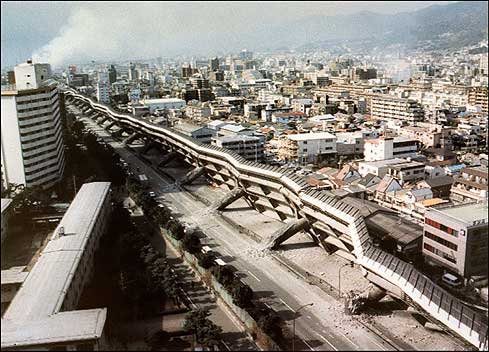
Some sections of the Hanshin Expressway suffered severe damage during the 7.2 magnitude Great Hanshin Earthquake which hit the Kobe, Japan area in January of 1995, killing over 5,500 people and costing over $200 billion.

(image credit: AFP / Jiji Press)

On the bright side, the affected sections of the highway did not "pancake", as happened in the 1989 Loma Prieta quake, but instead slipped sideways and tumbled over. Either way, one doesn't want to be driving through a highway interchange or junction when a big quake hits!

Recession, what recession?

Public works spending has long been the Japanese government's preferred way to spend budget surpluses, boost employment, keep the ruling party's supporters in the construction industry loyal, or all of the above. The highway depicted below is one of those projects, steadily overtaking a quiet city street like Godzilla in slow motion.

(images credit: Cisco's Japan Blog and Snegura)

Which came first, the highway or the building? The question is moot as both have learned to accommodate one another. The Hanshin Expressway takes a shortcut through the 5th to 7th floors of Fukushima's Gate Tower building, also known as the Bee Hive.

(images via)

The story goes that the original building's owner wanted to knock it down and rebuild, but was told by city planners that the space was being allocated to a newly planned exit of the expressway. Both sides refused to budge, and the compromise was completed in 1992.

(image via)

Tokyo residents can easily avoid using the highways and expressways which crisscross the city, thanks to one of the world's largest and most efficient subway systems, but when traffic is light they can be a pleasure to drive. The view can be pretty intense, as in the time-lapse photo below:

(image credit: Vladimir Zakharov)

Urban density in Tokyo is simply astounding:

(image credit: Sam Graf)

The Rainbow Bridge and the longest suspension bridge

Dark Roasted Blend has been covering some rather fascinating bridges before. Here are a few more - a spectacular sample from Japan. The 570 meter (1,870 ft) long Rainbow Bridge spans the northern (inner) part of Tokyo Bay and has been a city landmark since it opened in 1993. Two roadways, a transit line and pedestrian walkways all use the bridge, resulting in a seemingly chaotic tangle from certain angles.

(images credit: Uncharted Futures and lmkuzya)

It's at night, however, that the Rainbow Bridge comes alive with signature color! Spotlights mounted at strategic locations bathe the bridge's superstructure in prismatic glory. Best of all, the lighting is solar powered with energy stored during the day powering the light show at night:

(image credit: Gussisaurio)

Announced in 1969, the massive Kobe-Naruto highway route project stretches 81 kilometers to connect Japan's main island of Honshu with the much smaller island of Shikoku to the south. The jewel in the crown is the 4-kilometer long Akashi Kaikyo Bridge, which cost $3.6 billion to build over the ten year period between 1988 and 1998:

(image credit: Aurelio Asiain)

Of course, any discussion of Japanese highways wouldn't be complete without mention of Mount Fuji. The mountain's iconic snowy peak is visible from Tokyo - on clear days, at least - but though it's certainly possible to reach the dormant volcano's doorstep via highway, taking the Shinkansen bullet train is a better bet.

(image credit: fui)


This work is licensed under a Creative Commons license.